Thoughts and Ramblings of Life in US and the Philippines(Marinduque) and other miscellaneous topics close to my Heart.
Welcome to Marinduque-My Island Paradise
If this is your first time in my site, welcome! If you have been a follower, my heartfelt thanks to you, also. Help me achieve my dream, that someday, Marinduque will become a world tourist destination not only on Easter Week, but also whole year round. You can do this by telling your friends and relatives about this site. The photo above is Mt Malindig in Torrijos. Some of the photos and videos on this site, I do not own. However, I have no intention on the infringement of your copyrights. Cheers!
Marinduque Mainland from Tres Reyes Islands
View of Mainland Marinduque from Tres Reyes Islands-Click on Photo to link to Marinduque Awaits You
The following four classical pieces are my favorites. Listening to them lowers my blood pressure and relaxes me and I forget all the problems of the world. How about you, do you have any favorite classical music? Does classical music relaxes you?
Just recently, I receive an advertisement about Amanpulo Resort in Palawan. Sorry to say, I felt bad because this is the first time I heard of this resort. The last two years, I have been following the development of Bellarocca Resort in Marinduque, now touted to be the best resort(6-star) in Southeast Asia. But after reading the brochure of Amanpulo Resort and seeing the video(below), I have a feeling this resort is comparable if not better than Bellarocca. So, my dear readers if you have been to both Bellarocca and Amanpulo Resorts, I like to hear from you.
PAMALICAN ISLAND, THE PHILIPPINES:Amanpulo is located on the private island of Pamalican, set among the Quiniluban group of Cuyo Islands, 360km south-west of Manila. Lying along the trading routes from Southern China to Borneo, the Sulu archipelago and the Spice Islands, the Cuyo Islands have been known to sailors and traders since pre-Spanish days. The Cuyo archipelago has been largely forgotten since then. The people of these 40 islands live mostly by fishing and seaweed cultivation. Tourism has scarcely touched the islands. Seven square kilometres of reef surround the island. Beyond are sandbanks and a channel where whales, dolphins and sea cows have been glimpsed. At its widest point, the 5.5km island is only 500m across.
ACCOMMODATION Amanpulo’s native style of dwellings enhances its exclusive island allure. There are 40 casitas fashioned after a Philippine bahay kubo: a centuries old South-East Asian rural archetype where family life was played out beneath steep pitched roofs on timber frames. Amanpulo's 29 Beach Casitas each have private paths that lead through a tangle of bush directly onto the soft white beach. The beach is an uninterrupted wide stretch of fine sand with views over the neighbouring islands. The four Treetop Casitas are above the tree-line on higher ground. The five Hillside Casitas have unimpeded sea views and the resort's two Deluxe Hillside Casitas feature spectacular prospects of the Sulu Sea and neighbouring islands with both sunrise and sunset views.
Private holiday villas located just a few metres from the sea are available for rent at Amanpulo. There are eight 4-bedroom Villas, two 2-bedroom Villas and one 1-bedroom Villa. Each features a private swimming pool, separate bedrooms, living and dining pavilions, outdoor lounge and a kitchen. All villas include a cook, maid, and a buggy for each bedroom. Villa guests enjoy full use of all Amanpulo facilities and services. Amanpulo (peaceful island) is surrounded by white-sand beaches, turquoise waters and seven kilometres of coral reef commencing just 300m offshore. The coral island’s attraction lies in the pristine beauty of its environment and its complete exclusivity. Guests are greeted in Manila and flown by a 19-seat twin-engine plane, landing on the island’s private airstrip. THE BEACH CLUB - A garden walkway leads down from the pool to the white-sand beach and Amanpulo’s Beach Club. The open air pavilion is a tranquil setting. Mattresses and pillows are spread out on the deck, facing the sea. Shade umbrellas and reclining lounge chairs line the beach. Breakfast, lunch, dinner, snacks and refreshments are also offered at the Beach Club. Fresh seafood and Spanish cuisine are specialties. Here's a short video for your vieweing pleasure.
LAGOON CLUB - is located on the east side of the island and functions as an alternate beach club with similar features and amenities. Dinner is served and Vietnamese cuisine is a specialty.
PIZZA @ THE WINDSURF HUT Enjoy a large variety of pizzas cooked in a home-built wood-fire oven. Guests can relax in this tranquil environment with their feet in the sand. The Windsurf Hut opens for lunch.
PRIVATE DINING in a guest casita is available 24 hours. Private picnics and barbecues may be organized at Shigerino’s Place, Lagoon Sala, Shark’s Point Sala and the floating Kawayan Bar. Guests can also take picnic baskets on an island hopping trip or on a visit to the Sandbar. Picnic baskets may also be delivered to guest casitas. Other special venues for a barbecue are the guest casita beachfront, Gary’s Nest and Island Cave.
THE LIBRARY is stocked with novels in several languages, travel guides, newspapers, magazines and coffee-table books on Philippine art, design and culture. DVDs and CDs are available. Internet and Wi-Fi are available.
THE BOUTIQUES specialise in woven rugs, baskets, jewellery, pottery and other crafts from the Palawan region, as well as Asian antiques, furniture and island beach wear.
MASSAGE AND BEAUTY TREATMENTS can be taken in two air-conditioned Spa Casitas, the open-air Garden Sala or in the privacy of your own casita. Manicures, pedicures, facials and body treatments are also available.
MEETING ROOMS can be arranged at the West Villa Clubhouse for small gatherings; audiovisual equipment is available upon request.
THE GYM is located beside the tennis courts and surrounded by a lush tropical forest. Cardiovascular equipment is available.
THE SWIMMING POOL Amanpulo’s 30m Swimming Pool is bordered by two high bougainvillea trellises. The pool’s aquatiles mirror the Sulu Sea. Three spacious open-air salas are situated around the pool and feature generously-sized mattresses for all-day lounging.
TENNIS Four synthetic grass, floodlit tennis courts are available with rest pavilions for refreshments. Two courts are located adjacent to the Clubhouse and two are located adjacent to the West Villa Clubhouse. Complimentary tennis balls, rackets and playing partners are available.
SEA SPORTS HUT Adjacent to the Beach Club, the Seasports Hut offers a variety of water sports equipment as well as information on boat charters, water sports, snorkelling and scuba diving sites and sea conditions.
WEDDING BLESSINGS Renew your vows with a sentimental ceremony performed by a Filipino wedding official. A variety of romantic settings are available, including Amanpulo’s white sand beach at sunset, the outdoor chapel otherwise known as the ‘Grotto,’ beneath the bougainvillea-decked poolside trellis or at sea in a boat festooned with island flowers. Blessings include a guitar serenade, champagne, wedding cake, a decorated wedding car and a flower bouquet.
Note: This is No.1 of a series of articles on Beach Resorts in the Philippines that have attracted my attention. I am not paid to write this article and the future articles in this series.
Another city that I visited because of an American Chemical Society Meeting was Philadelphia, Pennsylvania way back in the mid 1980's. Again, Macrine was not able to join me, because of conflict on her work schedule. I did enjoy walking and window shopping at South Sreet and Society Hill. I also saw the famous Liberty Bell and Independence Hall and The Statue of Benjamen Franklin. I did enjoyed my 5 days visit of this historic city. Philadelphia (pronounced /ˌfɪləˈdɛlfiə/) is the largest city in Pennsylvania, sixth-most-populous city in the United States and the fifty-first most populous city in the world. In 2008, the population of the city proper was estimated to be more than 1.54 million, while the Greater Philadelphia metropolitan area's population of 5.8 million made it the country's fifth largest. The city, which lies about 45 miles (72 km) southwest of New York City, is the nation's fourth-largest urban area by population and its fourth-largest consumer media market, as ranked by the Nielsen Media Research.
It is the county seat of Philadelphia County, with which it is coterminous. Popular nicknames for Philadelphia include Philly and The City of Brotherly Love, from the literal meaning of the city's name in Greek (Greek: Φιλαδέλφεια (/pʰilaˈdelpʰeːa/, Modern Greek: /filaˈðɛlfia/) "brotherly love", compounded from philos (φίλος) "love", and adelphos (ἀδελφός) "brother").
A commercial, educational, and cultural center, Philadelphia was once the second-largest city in the British Empire(after London), and the social and geographical center of the original 13 American colonies. It was a centerpiece of early American history, host to many of the ideas and actions that gave birth to the American Revolution and Independence. It was the most populous city of the young United States, although by the first census in 1790, New York City had overtaken it. Philadelphia served as one of the nation's many capitals during the Revolutionary War and after. After the ratification of the U.S. Constitution, the city served as the temporary national capital from 1790 to 1800 while Washington, D.C., was under construction. Here's a tour of the city and the Amish country of Lancaster. PA. It will be worth your time to view this video, if you have not been to Philadelphia and surrounding area.
Philadelphia is central to African American history. Many of its larger suburbs such as Chester, Pennsylvania; Wilmington, Delaware; Camden, New Jersey; and Trenton, New Jersey (sometimes included in the New York metropolitan area) have African American majorities. This community has been large since before the Great Migration, and despite area civil rights gains, continues to be affected by poverty and high crime. The area, in common with most of Pennsylvania, also has a very large population of Italian Americans.
Note: This is No.25( Part 1) of a series of articles on places that the Katague Family had visited or resided in US since 1960.
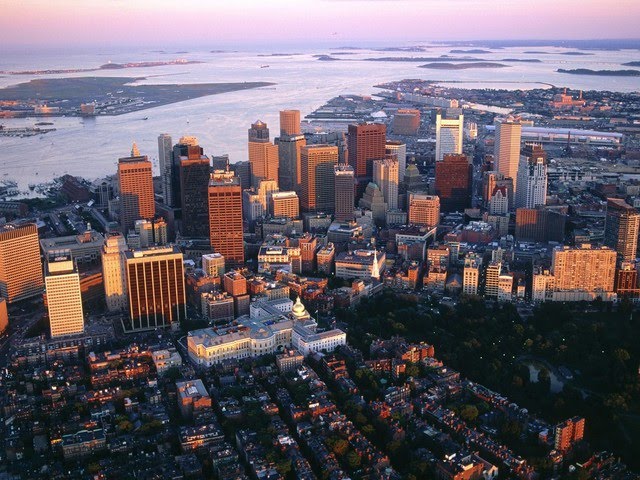
I attended another American Chemical Society Meeting in Boston, MA way back in the late 1970's. This was another city, that Macrine was not able to join me because of her job status. So without Macrine, my fellow FDA employees toured the city and surrounding vicinity before and after our meeting sessions. I did enjoy the historic monuments and antique homes and mansions and partake Maine Lobsters in one of the city famous seafood restaurants. We visited Faneuil Hall, a well-known stop on the Freedom Trail, sometimes called "the Cradle of Liberty" because of its role in the American Revolution. Boston is the city in America that is almost an extension of Europe.
Boston (pronounced /ˈbɒstən/) is the capital and largest city in Massachusetts, and is one of the oldest cities in the United States. The largest city in New England, Boston is regarded as the unofficial "Capital of New England" for its economic and cultural impact on the entire New England region. Boston city proper had a 2009 estimated population of 645,169, making it the twentieth largest in the country. Boston is also the anchor of a substantially larger metropolitan area called Greater Boston, home to 4.5 million people and the tenth-largest metropolitan area in the country. Greater Boston as a commuting region includes six Massachusetts counties, Essex, Middlesex, Norfolk, Suffolk, Plymouth, and Worcester, all of Rhode Island and parts of New Hampshire; it is home to 7.5 million people, making it the fifth-largest Combined Statistical Area in the United States.
Boston shares many cultural roots with greater New England, including a dialect of the non-rhotic Eastern New England accent known as Boston English, and a regional cuisine with a large emphasis on seafood, salt, and dairy products. Irish Americans are a major influence on Boston's politics and religious institutions. Boston also has its own collection of neologisms known as Boston slang.The city has a number of ornate theatres, including the Cutler Majestic Theatre, Boston Opera House, Citi Performing Arts Center, the Colonial Theater, and the Orpheum Theatre. Renowned performing-arts organizations include the Boston Symphony Orchestra, Boston Ballet, Boston Early Music Festival, Boston Lyric Opera Company, OperaBoston, and the Handel and Haydn Society (one of the oldest choral companies in the United States). The city is also a major center for contemporary classical music, with a number of performing groups, some of which are associated with the city's conservatories and universities. There are also many major annual events such as First Night, which occurs on New Year's Eve, the annual Boston Arts Festival at Christopher Columbus Waterfront Park, Italian summer feasts in the North End honoring Catholic saints, and several events during the Fourth of July period. These events include the week-long Harborfest festivities and a Boston Pops concert accompanied by fireworks on the banks of the Charles River.
Because of the city's prominent role in the American Revolution, several historic sites relating to that period are preserved as part of the Boston National Historical Park. Many are found along the Freedom Trail, which is marked by a red line of bricks embedded in the ground. The city is also home to several prominent art museums, including the Museum of Fine Arts and the Isabella Stewart Gardner Museum. In December 2006, the Institute of Contemporary Art moved from its Back Bay location to a new contemporary building designed by Diller Scofidio + Renfro located in the Seaport District. The University of Massachusetts campus at Columbia Point houses the John F. Kennedy Library. The Boston Athenaeum (one of the oldest independent libraries in the United States), Boston Children's Museum, Bull & Finch Pub (whose building is known from the television show Cheers), Museum of Science, and the New England Aquarium are within the city.
Boston has been a noted religious center from its earliest days. The Roman Catholic Archdiocese of Boston serves nearly 300 parishes and is based in the Cathedral of the Holy Cross (1875) in the South End, while the Episcopal Diocese of Massachusetts, with the Cathedral Church of St. Paul (1819) as its episcopal seat, serves just under 200 congregations. Two Protestant faiths are headquartered in Boston: Unitarian Universalism, with its headquarters on Beacon Hill, and the Christian Scientists, headquartered in Back Bay at the Mother Church (1894). The oldest church in Boston is King's Chapel, the city's first Anglican church, founded in 1686 and converted to Unitarianism in 1785. Other notable churches include Christ Church (better known as Old North Church, 1723), the oldest church building in the city, Trinity Church (1733), Park Street Church (1809), First Church in Boston (congregation founded 1630, building raised 1868), Old South Church (1874), and Mission Hill's Basilica and Shrine of Our Lady of Perpetual Help (1878). Here's a video on the sites and sound of this beautiful and historic city.
Note: This is No. 24 (Part 1) of a series of articles on the places that I had visited in the US since 1960.
The cherimoya (Annona cherimola) is a species of Annona native to the Andean-highland valleys of Bolivia, Chile, Colombia, Ecuador and Peru. It is a deciduous or semi-evergreen shrub or small tree reaching 7 m tall. The leaves are alternate, simple, oblong-lanceolate, 7–15 cm long and 6–10 cm broad. The flowers are produced in small clusters, each flower 2–3 cm across, with six petals, yellow-brown, often spotted purple at the base.
The fruit is oval, often slightly oblique, 10–20 cm long and 7–10 cm diameter, with a smooth or slightly tuberculated skin. The fruit flesh is white, and has numerous seeds embedded in it. Mark Twain called the cherimoya "the most delicious fruit known to men." This fruit is now grown in a farm in Santa Barbara, California. A friend from The Los Angeles area has a couple of cherimoya trees in his backyard.
The Moche culture of Peru had a fascination with agriculture and represented fruits and vegetables in their art. Cherimoyas were often depicted in their ceramics.
The tree thrives throughout the tropics at altitudes of 1,300 to 2,600 m (4,300 to 8,500 ft). Though sensitive to frost, it must have periods of cool temperatures or the tree will gradually go dormant. The indigenous inhabitants of the Andes say that although the cherimoya cannot stand snow, it does like to see it in the distance. It is cultivated in many places throughout the Americas, including California, where it was introduced in 1871, and Hawaii. In the Mediterranean region, it is cultivated mainly in southern Spain, Morocco, Madeira, Lebanon, Egypt and Israel. The first planting in Italy was in 1797 and it became a favored crop in the Province of Reggio Calabria. It is also grown in Taiwan, Australia and New Zealand.
The fruit is fleshy and soft, sweet, white in color, with a sherbet-like texture, which gives it its secondary name, custard apple. Some characterize the flavor as a blend of banana, pineapple, papaya, peach, and strawberry. Others describe it as tasting like commercial bubblegum. Similar in size to a grapefruit, it has large, glossy, dark seeds that are easily removed. The seeds are poisonous if crushed open and can be used as an insecticide. An extractive of the bark can induce paralysis if injected. When ripe the skin is green and gives slightly to pressure, similar to the avocado.
When shopping, one should look for large fruit which are uniformly green. Avoid fruit with cracks or mostly browned skin. Ripe fruit may be kept in the refrigerator, but it is best to let immature cherimoyas ripen at room temperature, until they yield to gentle pressure.
Different varieties have different characteristics of flavor, texture, and fruit shape contours. Contours can range from imprint areoles, flat areoles, slight bump or point areoles, full areoles - and combinations of the above. The flavor of the flesh ranges from mellow sweet to tangy/acidic sweet, with variable suggestions of pineapple, banana, pear, papaya, strawberry/'berry', and/or apple, depending on the variety. The usual characterization of flavor is 'pineapple/banana' flavor, similar to the flavor of the Monstera deliciosa fruit.
When the fruit is soft-ripe/fresh-ripe and still has the 'fresh' fully mature greenish/greenish-yellowish skin color, the texture is like that of a soft-ripe pear and papaya. If the skin is allowed to turn fully brown, yet the flesh has not fermented or gone 'bad', then the texture can be custard-like. Often, when the skin turns brown at room temperature, the fruit is no longer good for human consumption. Also, the skin turns brown if it has been under normal refrigeration for 'too long' -a day or two maybe.
Fresh cherimoya contains about 15% sugar (about 60kcal/100g) and some vitamin C (up to 20 mg/100g).Cherimoya and other members of the Annonaceae family also contain small amounts of neurotoxic alkaloids such as annonacin, which appear to be linked to atypical parkinsonism in Guadeloupe.
Sugar Apple or Ates in the Philippines
I have never tasted a cherimiya but I love a similar fruit that I grew in Marinduque called the sugar apple and locally known as ates.
Macrine and I visited New Orleans in the late 1970's during an American Chemical Society Meeting. We stayed at the Hyatt Hotel just across the Louisiana SuperDome and Convention Center. During the day, I attend the meeting , but after 5PM we were free to enjoy Bourbon Street and the French Quarters. We also took the bus tour of the city and surrounding areas. We attended a jazz concert. We saw the raised cemetery plots( above-ground tombs), antique homes and shoppes. It was a week to remember. Although, it was not Mardi Gras when we visited the city, there was always a long line during lunch and dinner time. We did enjoy the hurricane rum drinks and the ethnic dishes ( Creole).
New Orleans has many major attractions, from the world-renowned French Quarter and Bourbon Street's notorious nightlife to St. Charles Avenue (home of Tulane and Loyola Universities, the historic Pontchartrain Hotel, and many 19th century mansions), to Magazine Street, with its many boutique stores and antique shops. According to current travel guides, New Orleans is one of the top ten most visited cities in the United States; 10.1 million visitors came to New Orleans in 2004, and the city was on pace to break that level of visitation in 2005. Prior to Katrina, there were 265 hotels with 38,338 rooms in the Greater New Orleans Area. In May 2007 there were over 140 hotels and motels in operation with over 31,000 rooms.
A 2009 Travel + Leisure poll of "America's Favorite Cities" ranked New Orleans first in ten categories, the most first-place rankings of the 30 cities included. According to the poll, New Orleans is the best U.S. city as a spring break destination and for "wild weekends," stylish boutique hotels, cocktail hours, singles/bar scenes, live music/conerts and bands, antique and vintage shops, cafés/coffee bars, neighborhood restaurants, and people-watching. The city also ranked second for gay friendliness (behind San Francisco, California), friendliness (behind Charleston, South Carolina), bed and bath hotels and inns, and ethnic food. However the city was voted last in terms of active residents and near the bottom in cleanliness, safety, and as a family destination.
The French Quarter (known locally as "the Quarter" or Vieux Carré), which dates from the French and Spanish eras and is bounded by the Mississippi River, Rampart Street, Canal Street, and Esplanade Avenue, contains many popular hotels, bars, and nightclubs. Notable tourist attractions in the Quarter include Bourbon Street, Jackson Square, St. Louis Cathedral, the French Market (including Café du Monde, famous for café au lait and beignets) and Preservation Hall. To tour the port, one can ride the Natchez, an authentic steamboat with a calliope, which cruises the Mississippi the length of the city twice daily. The city's many beautiful cemeteries and their distinct above-ground tombs are often attractions in themselves, the oldest and most famous of which, Saint Louis Cemetery, greatly resembles Père Lachaise Cemetery in Paris.
Also located in the French Quarter is the old New Orleans Mint, a former branch of the United States Mint, which now operates as a museum, and The Historic New Orleans Collection, a museum and research center housing art and artifacts relating to the history of New Orleans and the Gulf South. The National World War II Museum, opened in the Warehouse District in 2000 as the "National D-Day Museum", is dedicated to providing information and materials related to the Invasion of Normandy. Nearby, Confederate Memorial Hall, the oldest continually operating museum in Louisiana (although under renovation since Katrina), contains the second-largest collection of Confederate memorabilia in the world. Art museums in the city include the Contemporary Arts Center, the New Orleans Museum of Art (NOMA) in City Park, and the Ogden Museum of Southern Art.
New Orleans also boasts a decidedly natural side. It is home to the Audubon Nature Institute (which consists of Audubon Park, the Audubon Zoo, the Aquarium of the Americas, and the Audubon Insectarium), as well as gardens that include Longue Vue House and Gardens and the New Orleans Botanical Garden. City Park, one of the country's most expansive and visited urban parks, has one of the largest (if not the largest) stands of oak trees in the world. There are also various points of interest in the surrounding areas. Many wetlands are in close proximity to the city, including Honey Island Swamp. Chalmette Battlefield and National Cemetery, located just south of the city, is the site of the 1815 Battle of New Orleans.
New Orleans is almost synonymous to Hurricane Katrina(2005). New Orleans was catastrophically impacted by the failure of the Federal levee system during Hurricane Katrina in 2005. By the time the hurricane approached the city at the end of August 2005, most residents had evacuated. As the hurricane passed through the Gulf Coast region, the city's federal flood protection system failed, resulting in the worst civil engineering disaster in American history. Floodwalls and levees constructed by the United States Army Corps of Engineers failed below design specifications and 80% of the city flooded. Tens of thousands of residents who had remained in the city were rescued or otherwise made their way to shelters of last resort at the Louisiana Superdome or the New Orleans Morial Convention Center. Over 1,500 people died in Louisiana and some are still unaccounted for. Hurricane Katrina called for the first mandatory evacuation in the city's history, the second of which came 3 years later with Hurricane Gustav.
Note: This is No.23 (Part 1) of a series of articles that the Katague Family had visited in the US since 1960.